HATRED AS IDENTITY
Identity, Algorithm, and Dehumanization in Adolescent Digital Radicalization
The H.M. Case (Calama, 2026) and the Latin American Contagion Effect
"Perhaps the great question is not 'what was this young person consuming,' but what vision of the world were they building inside themselves."
— Cinthia Gonzalez CastroPrologue: The Video That Is No Longer There
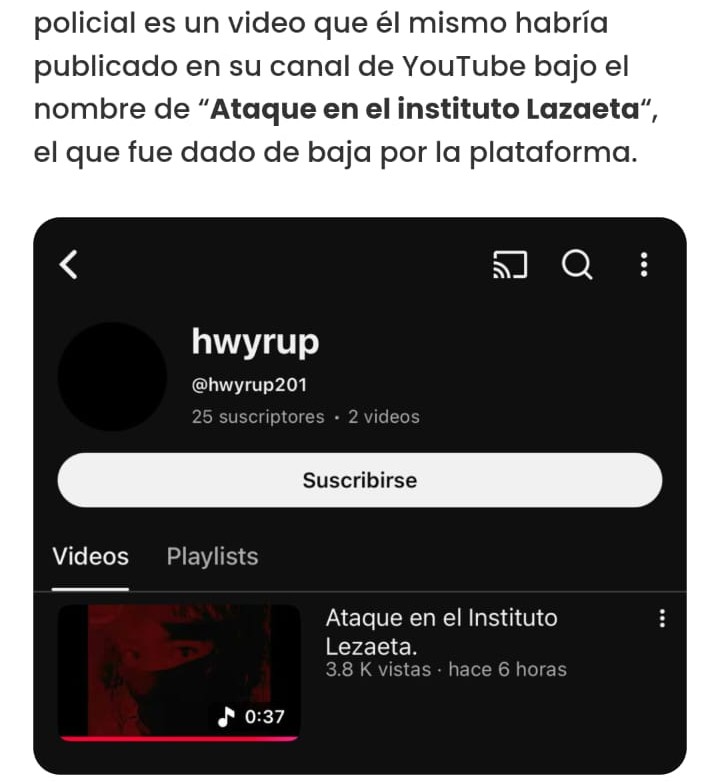
A day before the attack, a YouTube channel with barely 25 subscribers and 2 videos posted a clip of 37 seconds titled "Attack at Instituto Lezaeta". In it, a hooded young man threatened a teddy bear's neck with a bladed weapon while an English song played:
"I'm always lying around alone, I don't feel anything anymore, I think there's no hope for me. Damn it, killing all these cops, I'm piercing their brains. I shoot all these damn losers. What did they always call me? Crazy."
The video reached over 3,800 views in 6 hours. It was later removed by the platform. But captures existed.
Forensic investigations determined it copied the exact structure and aesthetic of the farewell video of Pekka-Eric Auvinen, author of the Jokela school massacre, Finland (2007). Weeks researching global school massacres to imitate.
Auvinen. Yamaguchi. Bekmansurov. Henderson.
Four surnames carved into the knives he carried on March 27, 2026. A portable pantheon.
How does one get there?
That question structures everything that follows.
Movement I: The Surface
The phenomenon, before analysis
I.1 — March 27, 2026
Instituto Obispo Silva Lezaeta, Calama. An 18-year-old enters hooded — ski mask and dark glasses — and heads directly to ask for the principal, a 59-year-old woman.
He carried an arsenal consisting of:
- Bladed weapons (machete/katana)
- Retractable baton
- Pepper spray
- Accelerant liquid configured as improvised flamethrower
One inspector killed, one teacher wounded, three students under fifteen injured. The attacker was neutralized and subdued by the school community on site. Carabineros and PDI Homicide Brigade confirmed the arsenal and the names carved into the weapons.
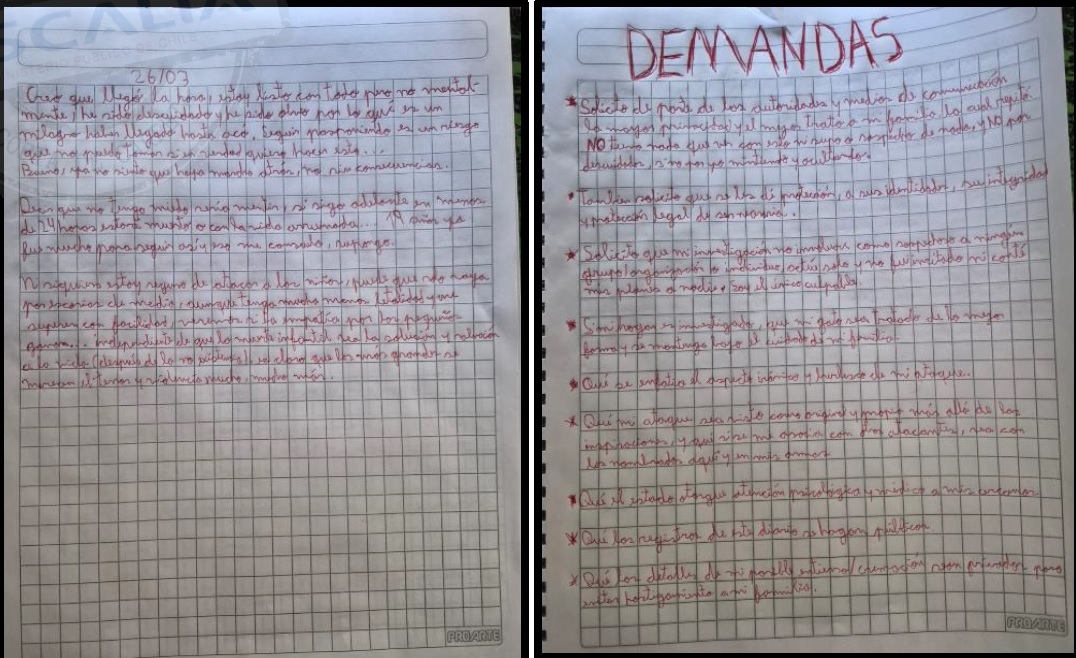
At his home, police found diaries and personal notebooks with 4 months of prior planning. In his writings:
- Explicit motivation of "hatred"
- A target of 8 victims
- Deliberate selection of first-grade children
- The premise: killing them to spare them the suffering of adult life
- The plan included the attack followed by immediate suicide
- He called the event his "day of wrath"
- The weaponry was gradually acquired on e-commerce platforms
I.2 — Who He Was
"Much is said about youth violence as if it appeared from nowhere, but it is the result of a slow and silent emotional deterioration."
— Author's notes
H.M., 18 years old at the time of the attack. He had been receiving mental health care since 2019.
The certified diagnoses presented to the detention control court:
○ Autism Spectrum Disorder (ASD) Grade 1
○ Major Depression
○ Panic Crisis
○ Moderate Anxiety-Depressive Disorder
The mother was well aware of her son's problems. In 2023 she submitted a neurological and psychiatric certificate reporting a sleep disorder. The school reduced his schedule to 10:00–13:00. Two years later, the mother requested attendance flexibility due to anxiety and depression on top of the autism spectrum diagnosis from 2021.
He rarely attended school. Some weeks he only went two days for a few hours, depending on his mood. He reached senior year with 32% attendance.
"Many young people are growing up with a deep sense of emptiness. Why? Emotional, psychological, psychiatric disorders — yes, all of that. But also social, family, and contextual conditions that cultivate them."
— Author's notes
75% of adolescents present anxious or depressive symptoms (ELPI 2024); one in three feels like a failure (SENDA 2025); 63% live with anxiety about the future, doubling WHO global averages (Frontiers in Education, 2025).
His classmates remember him as someone who went unnoticed. He had a group of friends he walked with at recess and had attended a birthday party. He had no history of bullying, either as victim or aggressor. He maintained cordial relationships.
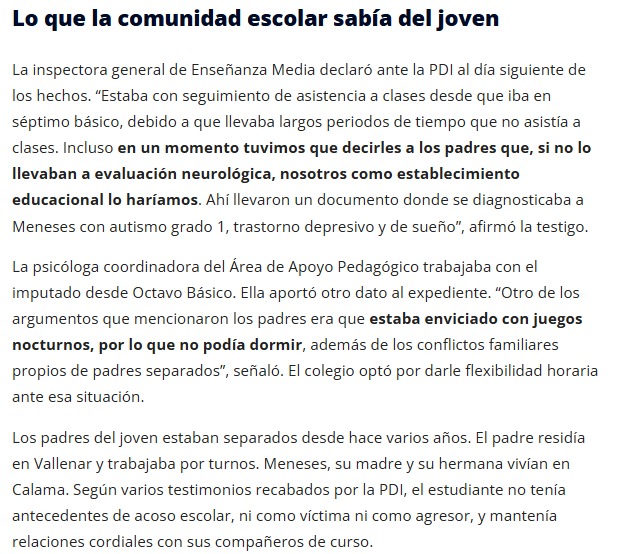
But the general high school inspector stated before the PDI the day after the events:
"He had been under attendance monitoring since seventh grade, because he had long periods of not attending classes. At one point we had to tell the parents that if they didn't take him for a neurological evaluation, we as the educational institution would do it."
The coordinating psychologist of the Learning Support Team had worked with the defendant since eighth grade. She provided another detail:
"Another argument the parents mentioned was that he was addicted to nighttime gaming, which prevented him from sleeping, compounded by the family conflicts typical of separated parents."
The young man's parents were separated. H.M., his mother and sister lived in Calama; the father lived in another region and worked shifts.
Timeline of signals
"Curiously, if we talk about this case, the signals were visible, very noticeable, but they were taken as humor, as a type of teenage exaggeration."
— Author's notes
An anonymous parent commented:
"I always saw him as a normal kid. My son hung out with him and told me he sometimes made comments about killing or burning people. No one took it seriously, they understood them as jokes."
Movement II: The Substrate
The environmental conditions of the phenomenon
Analytical Layer Map
⏶ Read from bottom up: from substrate to contagion network. Each layer builds on the previous one.
II.1 — The Linguistic System
"What concerns me is how certain digital spaces turn suffering into identity — through trends, concepts, fashions, references, ways of dressing, experiences and content that reinforce each other. The clearest example: the emo aesthetic and the display of bodily pain on social media, a verifiable trend on Tumblr, TikTok and image forums, where suffering ceases to be a private symptom and becomes a marker of belonging, a credential. This is how different groups have emerged, each with their own aesthetic, code and worldview."
— Author's notes
To understand how suffering becomes identity, one must start with the vehicle of that transformation: language.
The Code Glossary that the author compiles is not a list of slang. It is the backbone of an identity operating system. Each term fulfills a specific function in the construction of a new subjectivity:
Biological determinist nihilist doctrine holding that ugly or genetically inferior people are condemned to permanent social, emotional and sexual rejection, with no possibility of changing their status. It functions as a catalyst for deep hopelessness and the justification of violence as the only way out.
Verbal action code to manifest the intention of perpetrating a school shooting as a method of retaliation. "ER" pays direct tribute to Elliot Rodger, the 2014 Isla Vista attack, considered the "founder" of the violent incel strand.
Promotes absolute renunciation of social life, education, work and personal care, validating total apathy as a norm of group identity in the face of the impossibility of meeting social standards.
Chad: genetically perfect man, successful with women. Stacy: attractive young woman, hypergamous, despises incels. Roastie: misogynist epithet for women with active sex lives. All three objectify and dehumanize in a single move.
Internal secular canonization prefix used in the True Crime Community to elevate mass murderers of the past to deities or martyrs. "Saint Elliot", "Saint Pekka-Eric", "Saint Brenton." Their crimes as sacred acts of rebellion.
Video game jargon term adopted to refer to the net count of people killed in an attack. Users evaluate a perpetrator's "efficiency" based on whether they managed to beat the high score of previous massacres.
Covert code phrase for discussing suicide. Describes the perpetrator's planned action of taking their own life after carrying out the crime.
Concept drawn from Elliot Rodger's manifesto. Denotes the exact date chosen to execute a mass attack, framed as an act of justice and retribution against the environment that marginalized the perpetrator.
Defines members of the True Crime Community who worship Eric Harris and Dylan Klebold (Columbine 1999). They copy clothing (black trench coats), consume diaries, imitate postures, analyze manifestos to replicate them.
Numeric code of white supremacism. 14 = "Fourteen Words" (David Lane). 88 = H.H. (Heil Hitler). Direct indicator of neo-Nazi affiliation.
Digital illustrations from forums like 4chan. Used as profile pictures to self-identify as supremacists, incels or extremists. Linked to glorification of attackers like Patrick Crusius (El Paso 2019).
Doctrine holding that democratic institutions are completely corrupted and the only valid path is to commit acts of extreme violence not to reform the system, but to actively accelerate its total collapse.
| Question | Term |
|---|---|
| What is the world? | Blackpill |
| What do I do? | Going ER, LDAR |
| Who is the enemy? | Chad, Stacy, Roastie |
| What is good? | Saint (inversion) |
| How is success measured? | High Score |
| How does it end? | Catching the bus |
| When do I act? | Day of Rage |
| Who am I? | Columbiner, TCCer, Chudjak |
| Which side am I on? | 1488 |
| What for? | Accelerationism |
This is not a vocabulary. It is a secular theology designed for adolescents.
II.2 — The Algorithmic Amplifier
"Internet algorithms are capable of understanding who we are, how we feel, what we do, what interests us, etc."
— Author's notes
The second layer of the system operates in the technological infrastructure. It is not visible to those who inhabit it, but it determines the emotional trajectory of the content they receive.
The author describes a mechanism of three steps:
1. Emotional surveillance
The algorithm tracks not just clicks. It tracks affective states. "They are capable of understanding how we feel." The emotional dimension is the primary data, not the secondary.
2. Feedback reinforcement
"Thanks to this, it 'reinforces' what we are feeling, so to speak — the algorithm works by feedback. If you watch videos about murder once, more appear afterwards, each time 'more interesting'. If you play certain types of games, the algorithm recommends more similar ones."
— Author's notes
The key word is "more interesting". The algorithm does not passively replicate content: it intensifies it. It builds a narrative escalation that responds not to the user's intention but to the internal logic of reinforcement.
3. Repetition conditioning
"Depending on the user's preferences, if these are violent, dehumanizing, nihilistic, extremist, it will inevitably penetrate the mind and escalate more and more — there is an entire field of study on morbid curiosity and its psychology. Therefore I consider that the real danger is not always extreme content, but the constant repetition of these themes, messages, songs, memes, games, forums. It works subliminally, almost hidden, but constant."
— Author's notes
The author's crucial distinction: It is not isolated extreme content that radicalizes. It is the regime of repetition. An accidental disturbing video does not build a worldview. The constant repetition of thematic patterns — even if each individual piece is technically innocuous — does. The algorithm does not recommend: it builds emotional trajectories.
"DATA PRIVACY AND SURVEILLANCE NETWORKS, ALGORITHMS — the Meta case is paradigmatic: generating addictive videos, addictive content, well aware of the consequences."
— Author's notes
Studies with EEG and AI trained with brain process data have shown that, depending on the content consumed, it is possible to generate highly addictive or potentially harmful content. The engineering of emotional addiction is a verifiable business model (NBC News, 2026; CBS News, 2026).
The author places responsibility on the deliberate engineering of emotional addiction. It is not a side effect: it is the business model.
II.3 — Identity Reform
Central chapter — Author's thesis
"Something that concerns me is how certain digital spaces turn suffering into identity. [...] This has caused the person to stop seeing pain as something to overcome and instead transform it into part of who they are. This is not an impression: the psychological literature confirms it. It has been studied as a disorder of identity itself, a psychosocial foundation where the subject no longer feels pain but rather is the pain. Gabay et al. (2020) call it Tendency to Interpersonal Victimhood; Wilmore et al. (2025) link it with the Dark Factor of Personality. Recent research on digital adolescents speaks of a 'post-identity identity,' where the self dissolves and depends entirely on external validation (Díez Bajo, 2026). And constant comparison on social media is directly associated with identity distress (Systematic Review, 2024). All of this converges in what is known as victimhood personality — a pattern where the subject perceives themselves permanently as a victim."
— Author's notes
The author proposes that the core of the radicalization process is not ideological nor political: it is identity-based. The fundamental change is not in what the young person believes, but in what the young person is.
The process follows four phases:
Phase 1: Splitting
Pain ceases to be an emotional state and becomes a constitutive trait. The person no longer says "I am sad" (an emotion one has) but "I am a sad person" (an identity one is). The emotion migrates from the verb to feel to the verb to be. That grammatical leap is the ontological leap.
Phase 2: Validation
The digital community receives this pain-identity and confirms it. It does not question it, does not treat it, does not dismantle it. It welcomes it as a credential of belonging.
"If others validate it, it becomes fully accepted by the person. This is how environmental factors — context, people, platforms — can amplify and cultivate a mental disorder that might otherwise never have developed."
External validation converts an unstable self-perception into a solid identity. What was once a suspicion about oneself ("maybe I'm worthless") becomes a socially confirmed truth.
Phase 3: Fusion
The critical moment: the negative emotion is no longer something one feels but something one is. Identity fuses with emotional content until the subject can say:
"Like 'I am hatred', so to speak."
"I do not feel hatred" but "I am hatred". The ontological declaration replaces the psychological state. The subject is no longer the bearer of the emotion; the emotion is the subject.
Phase 4: Narrativization
Thoughts that began as private, isolated, shameful become shared narratives within the community. The person no longer has dark thoughts: they participate in a shared story about the world, the enemy, the mission and the end.
"Those 'dark thoughts' that began isolated suddenly become shared narratives, and you feel like you belong among people who understand you, but for those who don't, they become enemies, symbols, NPCs."
The author's age distinction:
For older adolescents (15+), dehumanization operates through identity construction/deconstruction: the subject actively builds a new digital self, deconstructing the previous one piece by piece.
For younger adolescents (<14), the mechanism is different:
"In the case of younger children there is another first barrier: the character they are occupying, what happens to their character they understand as their own."
The author describes here a phenomenon of play-based identity occupation: the young person does not build a new identity, but inhabits a character. Violence is not an expression of the self but of the character. But the boundary blurs when "what happens to his character he understands as his own."
The dehumanization spiral is bidirectional:
"The problem does not begin when someone threatens harm, but when they begin to completely lose their sense of humanity. When their radicalization reaches its emotional and existential core. They are not necessarily seeking to cause harm, they are seeking to stop feeling invisible."
— Author's notes
This phrase shifts the entire conventional framework of threat detection. The threshold is not the explicit threat (what adults look for). The threshold is the disappearance of the sense of humanity — one's own and others'. When the person no longer experiences themselves as human (but as character, as hatred, as icon), and no longer experiences the other as human (but as NPC, Chad, symbol), the moral containment mechanism has been deactivated.
Violence is not the goal. Visibility is the goal. Violence is the means to achieve it.
II.4 — The Abyss That Gazes Back
"Before, an isolated person was truly alone. Today, an isolated person can find thousands who think the same — malicious? perhaps, or maybe just equally lonely — they feel the same or feed the same destructive ideas."
— Author's notes
The author captures here a structural change in the nature of isolation:
Analog isolation (pre-2010): The isolated person was truly alone. Their dark thoughts had no social feedback. Isolation functioned as a buffer — protecting society from the individual and the individual from collective radicalization.
Digital isolation (post-2010): The isolated person is no longer alone. They find communities that validate, amplify and normalize their thinking. Isolation becomes a concentrator — instead of dispersing, it concentrates ideological energy.
"Why do I say they feed it? Because one thing is being sad, and another is starting to build an identity based on hatred, resentment, hopelessness, fatalism — and that is no longer a mood, it is a process of identity construction."
There is a step between "feeling" and "building." That step is community. The community that gives name, form and direction to diffuse discomfort. Without community, discomfort remains discomfort. With community, discomfort becomes identity.
And that identity comes complete: it not only diagnoses the world (Blackpill), but offers a place of belonging.
Belonging has a price: the dehumanization of those who do not belong.
"We forget that those around us whom we consider crazy also need to socialize, and therefore, seeking places where they can be understood and heard, they will find equally disturbed minds with whom to share dark experiences."
— Gaze into the abyss and the abyss gazes into you.
— Author's notes
The Nietzsche quote is precise. The author understands that radicalization is not unidirectional influence but reciprocal transformation between the individual and the symbolic system they inhabit. The abyss is not passive. It gazes back. And that gaze changes the one who looks.
"Social networks are normalizing extremely negative emotional states and even romanticizing them."
— Author's notes
The author mentions hybristophilia (sexual attraction to violent criminals): Ted Bundy, Charles Manson, Richard Ramirez receiving love letters in prison. Not as a curiosity, but as a symptom of an ecosystem that aestheticizes and romanticizes extreme violence.
"It strikes me how some young people seem to feel they have no future before even beginning adulthood. This is not an impression: Chilean data confirms it. ELPI 2024 shows that 75% of adolescents have anxious or depressive symptoms. SENDA 2025 found that one in three feels like a failure and 41% believe they are not good at anything. And a study in Frontiers in Education recorded that 63% of Chilean schoolchildren live with anxiety about the future, doubling WHO global averages. Hope has become scarce."
— Author's notes
The pattern repeats in multiple cases:
"In several cases a similar idea appears: 'I don't fit in', 'no one sees me', 'life has no meaning', 'I don't want to grow old'. That seems to repeat more than we imagine."
II.5 — The Irony Shield
"What concerns me is how ironic and dark humor is socially accepted to express violence. Making a very dark joke and having the whole group understand and enjoy it — there's an entry point we're not seeing."
— Author's notes
A parent:
"I always saw him as a normal kid. My son hung out with him and told me he sometimes made comments about killing or burning people. No one took it seriously, they understood them as jokes."
The author identifies the irony shield as a structural mechanism that allows radicalization to occur in public without being detected. The shield operates on three faces:
Face 1 — Social ("it was a joke" is irrefutable)
Dark humor is socially accepted as a vehicle for violence because intent cannot be fixed. Saying "it was a joke" closes any investigation. Anyone who insists on taking a joke seriously is accused of not understanding the code.
Face 2 — Psychological (protects the self from moral responsibility)
The perpetrator can explore violence without recognizing themselves as violent. "I was just joking." But the repetition of the joke normalizes the content until the boundary between fiction and intention blurs.
Face 3 — Systemic (no protocols for the ironic spectrum)
Educational institutions have protocols for explicit threats. They have no protocols for "dark humor." Detection systems are designed for the literal, not for the ironic spectrum where violence is said without being said.
"Delirium trigger: if you add an individual who does not associate with them, and a context like this is generated, the individual might try to imitate them, seek to relate for the sake of socializing, curiosity, morbidity, or because they have finally found a related group."
— Author's notes
The "delirium trigger" (the author's concept) describes the entry mechanism for individuals who do not naturally belong to these communities:
| Entry path | Mechanism |
|---|---|
| Social imitation | "I want to belong, so I adopt the group's humor" |
| Curiosity | "Is this a joke or real? I better find out" |
| Morbidity | "It disturbs me but I can't look away" |
| Identity contagion | "I understood the joke, now I'm part of the group that gets it" |
Irony acts as an emotional gateway drug. It allows exploring psychological territories that would otherwise be forbidden by the moral barrier. The problem is not the joke. It is what the joke normalizes after the hundredth repetition.
Movement III: Signals and Contagion
What the system failed to connect, how it expanded, and the question that remains
III.1 — The Signals No One Connected
"I think one of the biggest current problems is that institutions observe signals separately and fail to connect them to each other."
— Author's notes
The problem was not the absence of signals. It was their fragmentation.
| Who saw | What they saw | What they did |
|---|---|---|
| School (inspector) | 32% attendance, monitoring since 7th grade | Schedule flexibility |
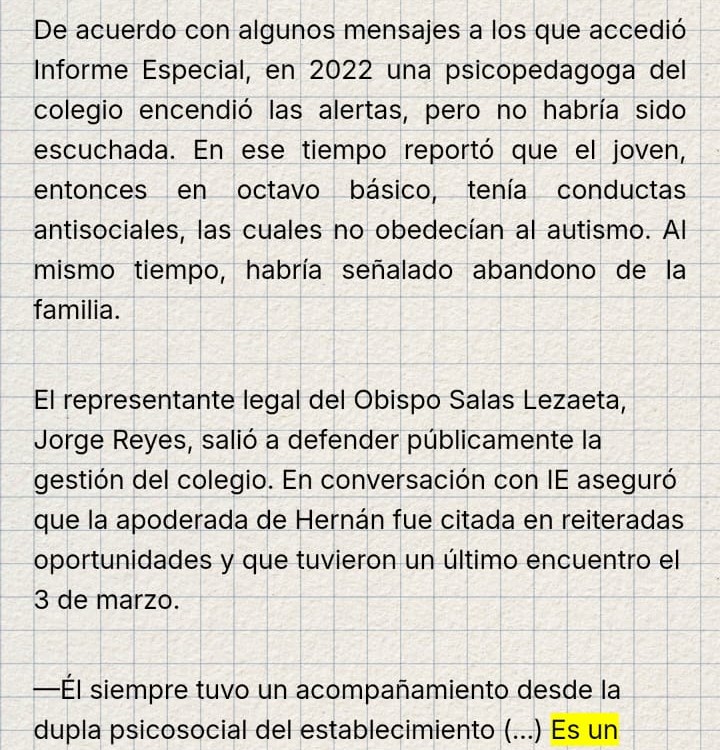
| School psychologist (2022) | Antisocial behaviors beyond autism, family neglect | Formal alert → no one responded |
| Psychiatrist (2019-2025) | ASD G1, Major Depression, Panic Crisis, Anxiety-Depression | Medical certificates |
| Mother | Isolation, nighttime gaming, sleep disorder | Medical consultations, certificates, meetings |
| Classmates | Violent comments, admiration for killers | "It was a joke" — did not report |
| YouTube | Video "Attack at Instituto Lezaeta", 3,800 views in 6h | Post-attack removal |
| Discord | Participation in Incelcore servers, neo-Nazi symbolism | No preventive action |
Each institution saw a part. None saw the complete pattern.
The author introduces an interdisciplinary metaphor to explain this failure:
"In cybersecurity, they speak of correlating events to detect threats. Perhaps something similar is missing in the human and educational sphere."
In cybersecurity, a single failed login attempt is nothing. A hundred attempts from fifty countries in three minutes is an attack. The difference is correlation. The author proposes exactly that for the human system: a system that correlates the signals that currently float in separate institutional silos.
But there is a darker layer. The testimony of a mother of one of the young people who witnessed the attack:
"At the school there have been many cases of rights violations. Quite a few, and it's all hidden for the school's prestige, because it's actually one of the best schools in Calama. To protect the prestige, they twist the children's versions."
The school's legal representative came out to defend their management:
"He always had support from the school's psychosocial team (...). We've had to expel several students. We've applied many Safe Classrooms protocols. We've sanctioned and suspended many students. We've never been sanctioned by the Superintendent of Education."
"Adults look for explicit threats, but do not pay attention to prior emotional deterioration."
— Author's notes
III.2 — Latin America as Laboratory
72 hours after the attack in Calama, on Monday March 30, 2026, at the Escuela Normal Mariano Moreno in San Cristóbal, Santa Fe Province, Argentina, a 15-year-old student entered with a 12/70 caliber shotgun that he took from his grandfather. He camouflaged it in a guitar case. The attack began during the national flag-raising ceremony. He said "surprise" and opened fire.
1 student killed, age 13. 2 wounded.
The profile: good student, no prior disciplinary sanctions, family conflicts, informal bullying reports. Days before he had explicitly threatened his peer group: "he would bring a weapon and everyone would die".
As in Chile, the student environment dismissed the warnings. They categorized them as jokes.
The Argentine investigation confirmed direct links to True Crime Community forums (TCC): a process of passive indoctrination where explicit violence is consumed, previous cases are studied, techniques are emulated, and one progressively deepens a worldview where mass attack is a possible destiny.
The contagion effect did not stop there.
In April 2026, students from multiple Latin American countries used social media anonymously or painted graffiti on walls and school bathrooms using the phrase "Tomorrow Shooting", specifying specific rooms or floors. The phenomenon generated collective panic and forced preventive evacuations and suspension of academic activities in Chile, Argentina and Uruguay.
Various minors were placed under juvenile court supervision. It was proven they were acting under internet viral challenge dynamics.
Brazil — Authorities identified a systemic increase in attacks with a common pattern:
Channels: Private Discord, Telegram, extremist imageboards
Ideology: Neo-Nazi + Misogyny + Glorification of massacres
Mechanism: Digital recruitment → accelerated radicalization → international supremacist influence → gamification (attacks as video game scoring)
Mexico — Criminal intelligence reports note constants:
1. Prior digital ideological manifestos
2. Farewell videos before the attack
3. Fascination and aesthetic imitation of US school shootings
4. Hate symbolism in virtual profiles
These are not isolated cases. They are a structural Latin American phenomenon.
III.3 — Digital Emotional Health
Author's proposal — Direct voice, minimal intervention
"I think we need to start talking more about digital emotional health and not just digital security. As a society we still don't really understand the psychological impact of being permanently connected to ecosystems designed to capture emotional attention."
— Author's notes
The author proposes a framework shift. It is not about adding more content control or more surveillance. It is about recognizing that the digital ecosystem not only processes information: it processes emotions, vulnerabilities and psychological states.
"It makes me think that today privacy is not only about personal data, but also about emotions, vulnerabilities and psychological states."
— Author's notes
"I think the most important human risk of this generation is not information theft, but the gradual loss of empathy, purpose and human connection (AI LOVE RELATIONSHIPS WTF?????)."
— Author's notes
The author's emotional parenthesis — the capitals, the question marks — is not a distraction. It is the recognition that the boundary between the human and the synthetic, the real and the performed, the felt and the constructed, is blurring in real time. And that adolescents are navigating this blurring without a map.
"Perhaps the great question is not 'what was this young person consuming,' but 'what vision of the world were they building inside themselves.'"
— Author's notes
That question shifts the entire framework:
- From consumption to production (the young person is not passive)
- From content to worldview (not just the what, but how they organize meaning)
- From symptom to structure (not what they feel but how their identity organizes around that feeling)
The author closes with three words that function as coordinates:
"Digital Security — Cybersecurity — Privacy"
But she actually proposes a broader framework that contains them:
Comprehensive Digital Health.
III.4 — Eight Theses
Before the abyss gazes back
Eight theses, one for each layer of analysis:
- Violence is not an event. It is the arrival point of an identity process. Slow, silent emotional deterioration is the terrain. The attack is the flowering. Looking only at the attack is understanding nothing.
- The algorithm does not recommend: it builds emotional trajectories. The constant repetition of content — even if each piece is innocuous — is more dangerous than isolated extreme content. The regime of repetition is the true radicalization machine.
- Suffering becomes identity when the community validates it. "I am hatred" is not a metaphor. It is the result of four phases (splitting, validation, fusion, narrativization) that turn an emotional state into an ontological declaration.
- Dehumanization is bidirectional. One dehumanizes the other (NPC, Chad, enemy) and dehumanizes oneself (character, avatar, icon). Both faces of the same spiral.
- Humor is not innocent. It can be the antechamber of dehumanization. Irony is the shield that protects radicalization from detection. "It was a joke" disarms any alert system.
- The signals were visible all along, but there was no system to connect them. The problem is not the absence of data. It is institutional fragmentation that prevents seeing the pattern. In cybersecurity this is called event correlation. In school mental health it has no name.
- Latin America is not a spectator. It is a laboratory for a global phenomenon with regional specificities. The Calama-San Cristóbal-Tomorrow Shooting-Brazil-Mexico case shows a transmission pattern that operates across borders, languages and educational systems.
- The question is not "how do we detect the next attacker" but "how do we dismantle the conditions that produce them." And that begins by recognizing that digital emotional health is not a luxury: it is a public health necessity.
The analysis has traced an arc: from silent emotional deterioration to manifest violence. The pieces of the case are on the board — not as a chronology, but as a system of connections. Each card is a fragment of the answer. Each thread, a relationship. The reader is invited to explore them in any order, discovering for themselves how suffering becomes identity.
— Interactive: hover to discover networks, click to pin, filter by tag.The Descent: Evidence Board
"Perhaps the great question is not 'what was this young person consuming,' but what vision of the world were they building inside themselves"
Blue — Psychological processes
Gold — Community and validation
Gray — Context and signals
Dashed — Secondary
Dotted — Contextual
Red — Alert signal
Blue — Prevention signal
Gray — Evidence or context
Brown — Key points
Epilogue: 37 Seconds
The video that is no longer on YouTube survives only in screenshots.
A hooded young man. A teddy bear. A katana at the bear's neck.
Three thousand eight hundred people saw it before it was removed. Some commented. Others shared. Most kept scrolling.
The video was called "Attack at Instituto Lezaeta." It was published on March 26, 2026. It was 37 seconds long.
The next day, a 59-year-old inspector was dead. Four people were wounded. An 18-year-old was subdued in the school courtyard, waiting for Carabineros.
On his knives he had carved the names of his saints: Auvinen, Yamaguchi, Bekmansurov, Henderson.
In his notebook he had written:
"Life has no value, because no one lives to see their impact or legacy, if they have one, the best you can do is make sure you leave something in the world before you go, and I made my decision."
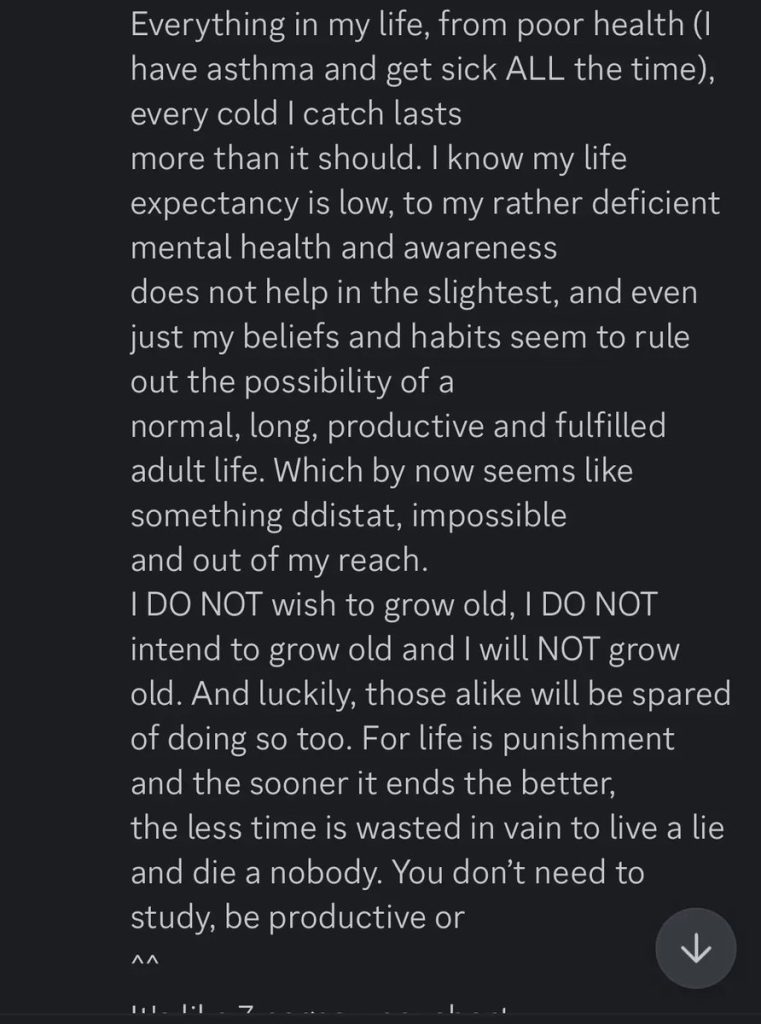
In his Discord manifesto:
"I do NOT wish to age, I have NO intention of aging and I will NOT age. Because life is a punishment and the sooner it ends, the better."
On his X account:
"The best way to release tension is to have a fresh corpse available to destroy and do whatever you want to it without consequences."
And in her notes, the author left behind the question that this article has attempted to address:
"Perhaps the great question is not 'what was this young person consuming,' but 'what vision of the world were they building inside themselves.'"
The 37-second video is gone. But the question remains open.
Appendices
Annex I — Complete glossary
| Term | Function | Definition |
|---|---|---|
| Blackpill | Epistemological framework | Biological determinist nihilist doctrine: genetic condemnation to rejection |
| Going ER | Action script | Code for perpetrating a school shooting as retaliation (Elliot Rodger) |
| LDAR | Behavioral norm | Absolute renunciation of social life (Lay Down and Rot) |
| Chad | Enemy taxonomy | Genetically perfect man, object of resentment |
| Stacy | Enemy taxonomy | Attractive young woman who despises incels |
| Roastie | Enemy taxonomy | Misogynist epithet for women with active sex lives |
| Saint | Value system | Secular canonization of murderers as deities or martyrs |
| High Score | Measurement system | Victim count as video game score |
| Catching the bus | Exit protocol | Planned post-attack suicide |
| Day of Rage | Narrative structure | Attack date as act of retribution (Elliot Rodger) |
| Columbiner/TCCer | Identity label | Harris & Klebold fanatics, members of True Crime Community |
| 1488 | Political affiliation | Neo-Nazi code: 14 words + Heil Hitler |
| Chudjak/Poljak | Self-representation | Incel/supremacist identification memes |
| Accelerationism | Teleology | Violence to accelerate system collapse |
Annex II — Timeline 2016-2026
Annex III — Map of Latin American cases
| Country | Date | Perpetrator | Modus | Victims | Digital pattern |
|---|---|---|---|---|---|
| Chile (Calama) | 27 mar 2026 | 18 years | Bladed weapons + flamethrower | 1 dead, 4 wounded | Discord Incelcore, YouTube, Chudjak |
| Argentina (San Cristóbal) | 30 mar 2026 | 15 years | 12-gauge shotgun | 1 dead, 2 wounded | True Crime Community |
| Brazil (pattern) | 2024-2026 | Multiple <18 | Firearms/bladed weapons | Multiple | Discord, Telegram, neo-Nazi + gamification |
| Mexico (pattern) | 2024-2026 | Multiple <18 | Firearms | Multiple | Manifestos, goodbye videos, hate symbols |
| Regional | Apr 2026 | Multiple <18 | Online threats | 0 (mass panic) | "Tomorrow Shooting" as viral challenge |
Annex IV — References and sources
The numbered sections correspond to active searches conducted to address the author's investigative markers.
1. Case sources
- Latercera: "The day after the survivors of the Calama tragedy" — link
- BioBioChile: "The macabre manifesto of the Calama school shooter" — link
- Argentina.gob.ar: "School massacre in San Cristóbal" — link
- Usach.cl: "Incelcore: the inspiration H. M. had for his attack in Calama" — link
2. Victimhood personality and identity
- Gabay, R., Hameiri, B., & Halperin, E. (2020). Tendency to Interpersonal Victimhood (TIV).
- Wilmore, T. et al. (2025). Exploring self-victimhood's place in moral personality and unethical organizational behavior. International Journal of Personality Psychology.
- Muñoz, E. (2025). El victimismo crónico. Centro de Psicología Canvis. — link
- Psicologiaymente.com: Victimhood personality — link
3. Digital identity and adolescents
- A Systematic Review of Social Media Use and Adolescent Identity Development (2024). Adolescent Research Review, Springer. — link
- Identity Construction and Digital Vulnerability in Adolescents (2025). MDPI. — link
- Díez Bajo, C. (2026). Construcción de identidades múltiples en la adolescencia: hacia una identidad posidentitaria. Tendencias Sociales. — link
- Psiachos, J. et al. (2025). Identity status and gender differences on externalizing problems and social media addiction. RPPC. — link
4. Algorithmic responsibility and Meta Case
- Jury finds Meta and YouTube negligent in landmark social media addiction lawsuit (25 mar 2026). NBC News. — link
- Meta and YouTube found liable on all charges (25 mar 2026). CBS News. — link
- School District Settles Claims Against Meta (22 may 2026). Law.com. — link
5. EEG, AI and addictive content
- Classification of internet addiction using ML on EEG (2025). Psychological Medicine, Cambridge. — link
- EEG reveals cognitive impact of polarized content in short video scenarios (2025). Scientific Reports, Nature. — link
- Neural Efficiency and Attentional Instability in Gaming Disorder (2026). MDPI. — link
6. Psychology of morbid curiosity (Morbid Curiosity)
- Scrivner, C. (2021). The psychology of morbid curiosity: MCS scale. Personality and Individual Differences.
- Morbid curiosity as an adapted motivation (2026). PubMed. — link
- Behavioral attraction predicts morbidly curious women's mating interest (2024). Personality and Individual Differences.
- Curious about threats: Morbid curiosity and conspiracy theories (2024). British Journal of Psychology.
7. Youth and hopelessness in Chile
- Encuesta Longitudinal de Primera Infancia (ELPI) 2024. Ministerio de Desarrollo Social, Chile. — link
- Relación del nihilismo existencial con ansiedad, depresión, estrés en Chile (2025). ScienceOpen.
- Adolescent mental health in Chile: mayor estudio comunal (2025). Futuro Chile. — link
- Youth crisis in Chile: 63% con ansiedad por el futuro (2025). Frontiers in Education. — link
- Youth and Wellbeing Survey (2025). SENDA, Chile. — link
8. Affective relationships with AI
- Swipe right on AI: Psychological profiles behind chatbot love (2026). Current Psychology, Springer. — link
- Secret Soulmates: AI Romantic Companions Impact Real-Life Relationships (2026). Wheatley Institute, BYU. — link
- Outsourcing Love: Virtual Girlfriend Experience (2026). Evolutionary Psychological Science. — link
9. True Crime Community and nihilistic subcultures
- ISD (2026). The online landscape of subcultures of nihilistic violence. — link
- Sivignon, P. (2026). Escape The Void. GNET. — link
- Herberhold, A. (2026). The TCC Stoplight Model. GNET. — link
- Nocte, C. (2026). Distinctive Hallmarks: Investigations into NVE. GNET. — link
10. Incelcore and misogynist radicalization
- The radicalisation loop in an incel forum (2026). Current Psychology, Springer.
- Radicalization within a network of misogynist extremists (2025). Humanities and Social Sciences Communications.
- Incelcore. Wikipedia (updated May 24, 2026). — link
- Incel Radicalization Europe (2026). Learning For Youth. — link
11. Contagion effect
- Towers, S. et al. (2015). Contagion in Mass Killings and School Shootings. PLOS ONE. — link
- Exploring the contagion effect of social media on mass shootings (2022). Computers & Industrial Engineering.
- Andrade Melo et al. (2025). Mass shootings and copycat effect: global prevalence outside the U.S. U. Salamanca. — link
12. Cases referenced in the attacker's pantheon
- Pekka-Eric Auvinen — Jokela, Finland, 2007
- Elliot Rodger — Isla Vista, USA, 2014
- Eric Harris & Dylan Klebold — Columbine, USA, 1999
- Patrick Crusius — El Paso, USA, 2019
- Timur Bekmansurov — Perm, Russia, 2021
- Otoya Yamaguchi — Japan, 1960
- Solomon Henderson — USA, 2025
May 28, 2026